Starting a business in the UK is an amazing opportunity. It’s your chance to get your idea, your passion, or your skills out in the world, and become your own boss.
But, it’s also no secret that not all businesses make it. In fact, 1 in 5 new businesses fail in the UK every year. The way to make sure that you don’t become one of them (and ease that fear of failing!) is to make sure that you have all the information at your fingertips and plan carefully before you take the leap.
To help with that, we’ve created this FAQ for everything you need to know about starting a business in the UK.
1. How do you start a business in the UK?

To register your business (and officially start it!), you need to pick a business structure. This determines how you register, how you pay tax, and ultimately what liabilities you’re responsible for and what protections your business will get.
Over 90% of start-ups in the UK choose to be a sole trader, or a limited company.
Being a sole trader means that you are the exclusive owner, and ultimately responsible for every aspect of your business. Setting up as a limited company means that your business is a separate legal entity – which gives both more protections, more responsibility and more paperwork.
We’ve explored the differences between a sole trader and limited company in detail here, but at a glance here’s the core information to help make a decision.
| Feature | Sole Trader | Limited Company |
| Structure | You are personally responsible for your business and all business debts. | Your business is its own legal entity, so you are only personally responsible for any personal investment in it. |
| Payments | All the profits are yours (after your personal Income Tax and National Insurance payments). | You have to pay yourself a wage, and you can pay yourself profits from the company through methods like dividends or director’s loans. |
| Registration | You need to register for Self Assessment with HMRC by 5 October following the end of the tax year in which you earn over £1,000. | You must register the company with Companies House before you do any business. |
| Taxes | You need to pay Income Tax and National Insurance through Self Assessment. | Your business has to pay Corporation Tax on its profits. |
| Admin & Records | Simple record-keeping of income and expenses. | Must file official company accounts and tax returns following strict rules. |
| VAT & Employees | Must register for VAT if threshold is met. Can hire employees. | Must register for VAT if threshold is met. Can hire employees. |
Remember: it’s fairly easy to transition from a sole trader to a limited company if you want to start as one and change as you grow. Your decision now doesn’t have to be permanent.
Starting A UK Business?
Get rid of the confusion and always know what to do next with Startup Hive, the step-by-step platform created by the Business4Beginners team.
- FREE Step-By-Step Platform
- FREE Bank Account
- FREE Bookkeeping Software
- FREE Email Platform
- FREE Domain Name
- Discounted Company Formation
- Plus Much, Much More!
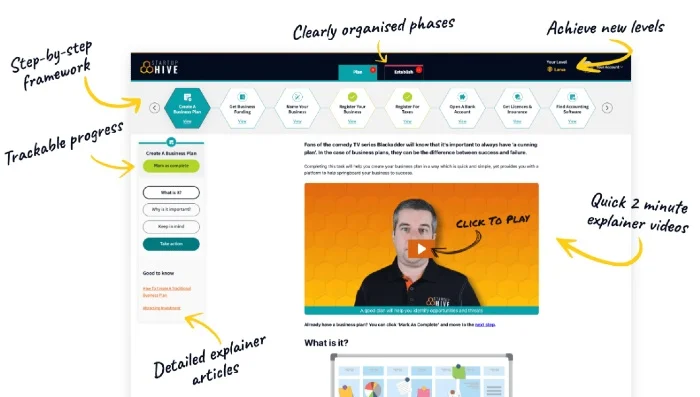
Join today for 100% FREE access to the entire Plan & Establish phases, taking you from validating your business idea through to setting it up, getting your accounts sorted, and creating a website.
“Excellent guide to build your business”
“The perfect starting point”
“Incredibly simple and intuitive to use”
Startup Hive is your trusted companion as you look to turn all of your business dreams into reality. Join today for free.
—
2. How do I register my business?
The way you register your business depends on the type of structure you choose.
If you want to set up as a sole trader, all you need to do is register as a sole trader with the HMRC and make sure you’re registered for self-assessment. You don’t even need to do this straight away – you can start trading first. The deadline for registration is when you earn more than £1,000 in a tax year.
If you’re forming a limited company, you need to register before you start trading. This process is a bit more complicated, and includes having to create official documents, appoint directors, allocate shares and apply to register your business with Companies House.
The full guide and process to setting up a limited company can be found here. However, if you want to make this a lot quicker and easier, you can make use of Company Formation Agents who will do this entire process for you. Even better, they can also provide extra services such as registered office addresses to protect your privacy and add prestige to your company.
If you want to go down this route, we’ve reviewed and tested the best formation agents in the UK to help find your perfect match.
Top-Rated Company Formation Agents
| Formation Agent | Cheapest Package | Add On Services | Our Rating | Review | Official Site |
|---|---|---|---|---|---|
 | £102.99 | Excellent | 9.4 | Read Review | Visit Website |
 | £19 | Average | 9.4 | Read Review | Visit Website |
 | £102.99 | Excellent | 9.3 | Read Review | Visit Website |
3. How much does it cost to start a business?

The cost of starting a business varies widely depending on the type of business you’re starting and the industry you’re in. If you’re a service-based sole trader, you might expect costs between £100-£1,500. If you’re planning on setting up as a retailer, costs will typically be higher, expecting anywhere between £2,000 – £15,000+.
But these are just estimates. To get a realistic ballpoint, you need to look at what costs you are likely to come across for your business.
There are three types of costs you need to think about:
- Investigatory costs, which cover anything you need to research your market or business. For example: buying competitor products, running surveys or panel groups, or any consultancy fees.
- Pre-launch startup costs, which cover all the items you need to prepare for trading. For example: equipment, formation fees, training and qualifications, office furnishings, and initial inventory.
- Post-opening startup costs, which cover everything you need and daily running costs after your business is officially launched and trading. For example: insurance, payroll, utility bills, licensing, stock management, rent and finance repayments, and any advertising, marketing and promotion.
To help you get an idea of what costs to expect for your business (and prepare you for any hidden costs you might not expect!), see our checklist on the 15 startup business costs to consider in the UK.
4. How do you fund a business?
There are many ways that you can get the money needed to fund a business. These include:
- Self-funding through personal savings or loans.
- Using business loans, or government-backed start-up loans.
- Getting investors to inject money into your business.
- Using grants and schemes.
- Crowdfunding through platforms like Kickstarter.
We’d always recommend looking at available grants when starting a business – as this gives you access to money without having to pay it off. There are multiple types of grants available, including:
- Small business and startup grants
- Grants for young entrepreneurs
- Employment grants
- Innovation and R&D grants
- Regional and sector-specific grants
- Export grants
Find out more about grants for your business and how to apply for them here.
5. Do I need a business bank account?
This depends on what type of business you have.
Sole traders can use personal bank accounts (if their bank allows it). However, many people prefer to use business bank accounts because it helps separate your personal finances from your business ones.
Limited companies legally require a separate dedicated business bank account because the company is a distinct legal entity.
Often, you can get better bank rates and access to loans through business bank accounts, which make them a great asset for your company. To find out more, discover our complete guide to business bank accounts.
6. What taxes do I have to pay as a new business in the UK?
The tax you are liable for will depend on how you set up your business (and how much profit you make!).
For sole traders, you pay both Income Tax on profits above your personal allowance (currently £12,570) and Class 4 National Insurance. This is done every year through your self-assessment.
For limited companies, you are charged Corporation Tax on profits. This is at a rate of 19% for profits up to £50,000, rising to 25% for profits above £250,000. You will also have to pay tax on any profits that are paid out as dividends.
If you have employees, you have to pay 15% Employer NI on earnings above £5,000 per employee per year.
| Tax Name | Who Pays It? | Key Threshold or Rate |
| Corporation Tax | Limited Companies | 19% on profits under £50k; up to 25% on profits over £250k |
| Income Tax | Sole Traders | Personal Allowance up to £12,570 (0%), then 20%–45% basic/higher rates |
| Class 4 NI | Sole Traders | 6% on profits between £12,570 and £50,270 |
| Employer NI | Any Businesses with employees/directors | 15% above £5,000/yr per employee (offset by £10,500 Employment Allowance) |
7. How do I manage my business finances?
Keeping on top of your finances is an important part of running a successful business. Bookkeeping is an incredibly important skill that won’t just help your business thrive, but save you a lot of money and time in the long run.
At the most basic level, you need to keep records of all your income and all your expenses.
If you’re a sole trader, all you need to do is use these records to submit your self-assessment each year. As a limited company, this process is a little trickier and you’ll need more detail to submit your annual reports – so it’s very important that you set up a great system of recording and monitoring your business finances.
Businesses’ finances are something that you can choose to manage yourself, or you can hire an accountant to help take some of the pressure off. But whichever option you go for, the best and easiest way to get your records straight is to use accounting software, such as FreeAgent or ANNA Business Tools.
Accounting software will save you time and stress, giving you access to tools that automatically track your income and expenses, allow you to make invoices, and get real-time insights into your cash flow and financial health. To find the right option for your business, take a look at our reviews designed for start-ups and small UK businesses.
EXCLUSIVE OFFERS – Save On Your Accountancy Costs


8. Do I need a business plan?
Business plans are an invaluable asset for businesses. Although it isn’t technically a requirement (unless you plan on taking out a business loan or getting an investor), business plans could be the difference between your business flourishing and failing.
As we cover in our guide to business plans, when used right, they become your personal roadmap to success, a living document that guides your decisions, clarifies your goals, and helps you navigate the inevitable challenges of starting a business.
9. How do I write a business plan?
Writing a business plan involves putting clear definitions of what your business is, your goals, and how you will achieve them into a formal document. That may sound daunting, but the structure follows a relatively simple outline.
- Executive Summary: A high-level overview of your business concept, target market, mission, and financial ask.
- Business Description: Detail your legal structure (Sole Trader vs Limited Company), what problem your business solves, and your Unique Selling Proposition (USP).
- Market Analysis & Competitor Research: Identify your ideal customers, the size of your market, and what competition you will face.
- Products & Services: Describe what you are selling, how you will sell it and what your pricing structure is. If you’re selling physical products, you will also need to detail any supplier or manufacturing details here.
- Marketing & Sales Strategy: This is where you describe how you will get, and keep, customers. It will go into aspects like social media, websites, promotional materials and more.
- Operations & Management: This is where you look at the day-to-day running of your company, as well as any equipment needs, staff roles, legal compliance, and relevant insurance.
- Financial Projections: Provide a 3-year forecast including cash flow statements, profit and loss estimates, and a break-even analysis.
Don’t worry though – you don’t need to start from scratch. Follow each step with us in our guide to writing a business plan.
FREE Download:
The Business Success Planner
Set clear goals for your business
Plan and manage your time more effectively
Brainstorm ideas and log inspirations
Stay motivated and encouraged

10. Do I need any permits or licenses for my business?
You only need a business license or permit for certain types of businesses or industries, such as food and hospitality, childcare, financial services, or waste removal.
At a glance, the common licenses and permits needed are as follows:
| Business Sector | Primary Licence / Registration Needed | Regulator or Approving Body |
| Cafes & Food Retail | Food Business Registration & Premises Approval | Local Council / Food Standards Agency |
| Retail & Salons | PPL PRS Music Licence (if music played) & ICO Fee | PPL PRS & ICO |
| Childminding / Nurseries | Early Years / Childcare Registration | Ofsted (England) |
| Trades & Construction | Waste Carrier License (if transporting debris) | Environment Agency |
| Professional Services | Data Protection Fee (ICO) | Information Commissioner’s Office |
You can find out the exact type of license you need using the government license database.
Ready to start a business in the UK?
We’re here to help you every step of the way. If you’re ready to get started, why not take a look at our checklist for starting a business in the UK – or even explore our dedicated guides for starting certain types of businesses, including:
- How to start a vending machine business
- How to start a hairdressing business
- How to start a business as a heating engineer
- How to start a dog grooming business
- How to start a knitting business
No matter what business you want to start, or where you are on your journey, we’re always here for you at Business4Beginners.