No matter what your business does, or what industry you’re in, every business needs a solid approach to accounting. While you’d probably rather focus on your business than your accounts, the reality is that having a good grasp of your finances is crucial for success.
Accurate bookkeeping is essential because it saves you time and money in the long run. Since “death and taxes” are the only certainties in life, it’s best to tackle your accounting needs head-on.
But does that mean that you need to invest in accounting software, or should you stick to going it alone? We’re here to help you find the answer by exploring the pros and cons of accounting software for small businesses.
Accounting software has come a long way
Before we dive into the pros and cons of accounting software, it is important that we mention that accounting software has evolved and changed a lot over the past decade.
The idea that all accounting software programs are clunky, hard-to-use spreadsheets is no longer true. Modern accounting software has helped revolutionise how businesses manage their finances, offering many innovative features and automatic bank tracking, invoicing, and more.
However, the exact features (and how easy it is to use!) will vary for each accounting software. This guide will look at the advantages and disadvantages of accounting software as a whole, but if you decide it is right for your business, you will need to check out our in-depth reviews to find a program that fits your needs.
Lost the buzz for your business?
Starting a business is exciting. Succeeding is rewarding. The bit between is hard, repetitive, and full of self-doubt.
The Lonely Middle Club (From Business4Beginners) helps you through it:
Get support and advice from other small business owners
Remove the self-doubt that’s holding your business back
Learn techniques and strategies to grow your business faster
Be inspired with our exclusive ‘swipe’ file and AI-powered tools
No pressure – work at YOUR pace, towards YOUR goals
—
The top 8 advantages of accounting software
Okay, it’s the moment you’ve been waiting for. Let’s dive into the top seven pros of using accounting software for your small business.
1. It saves you time
Accounting software is designed to make accounting easier and faster. Instead of having to rely on manual data entry and keeping accurate records of every receipt, accounting software will automatically connect to your accounts and record all this data for you.
And depending on the software you choose, you can also free up more time by using automatic invoicing or payroll solutions, saving your business even more time.
As the saying goes, time is money. The less time you have to spend doing and worrying about your accounts, the more time you can invest in your business and drive your success.
2. Less human error
Accounting software automatically pulls information in from your accounts, which not only saves time but also removes the chances of human error that could have happened if you were to do everything manually.
This not only gives you better peace of mind but also improves your accuracy, giving you more reliable financial records to make decisions based on.
A University of Cambridge study has shown that the use of accounting software increases the quality of financial reporting. (Bangerter and Afaro-Almagro, 2024) This doesn’t just help your small business when sending your tax return, but also to make better decisions based on your finanical situation.
3. Real-time financial insights
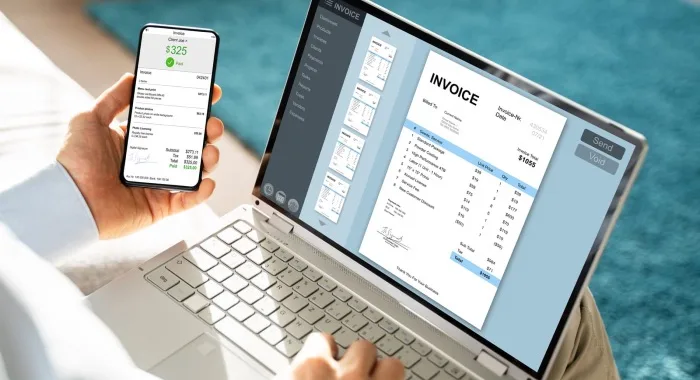
Accounting software is great at giving you a real view of your financial situation at any given time. If you need to make a decision, or if you’re checking the day-to-day health of your business, you’ll have the real data at your fingertips without having to break out the calculator.
Some software will even provide you with various reports automatically. Once set up, you get them regualarly into your inbox, giving you the vital financial overview you need to make your small businesses a success.
Studies have also shown that using accounting software has a positive impact on performance for small businesses, making businesses more effective. (Wickramsainghe et al., 2017) So there is scientific evidence that using a bookkeeping software can help your business be more successful.
4. It helps keep you compliant
Most accounting software is built to be Making Tax Digital (MTD) compliant and will constantly stay up to date with the latest tax rules and regulations. This means that not only will they be able to help you create and file your reports, but also be able to flag any potential problems before it’s too late.
5. It’s easy to share with your accountants
Most accounting software platforms have account seats, which allows your accountant to be able to access and check your accounts for you. This is not only an easier way of sharing information with your accountant, but it will also save a lot of time (and reduce those billable hours!).
For us here at Business4Beginner this feature is very important. When the time comes to file our corporation tax, our accountant just has to log into our accounting software, check that everything is in order and file our corporation tax return.
No sending spreadsheets and receipts, because it’s all in one place, easy to access for us and our accountant.
6. Accounting software grows with you

Accounting software is available on a range of price plans and points dependant on what your business needs. Which means that as your business grows, you can simply upgrade plans and have an accounting solution that grows and scales with your needs.
This means you don’t have to pay for services you don’t need. You can opt for a basic plan when you first start out, and move to a more advanced option as your business grows.
Especially when budgets are tight, this can help you keep costs down without having to miss out on a technology that can make your life so much easier.
7. Keep your data secure
Accounting software utilises a range of security features, including encryption and data backups, to safeguard your data, particularly when compared to DIY methods such as using spreadsheets or storing paper receipts in a folder.
8. Can help with your cash flow
We have already seen that the use of accounting software can have many benefits for small businesses. And here is another one, that is very handy indeed.
Accounting software can help you with your cash flow. A study has shown that using such technology can be a great weapon against late payments, which impact hugely on cash flow. (Osinowo 2018)
This makes sense, because bookkeeping software gives you better quality data and reports, which tells you when payments are late. Knowing this is the first step to sorting it and get your invoice paid.
Many accounting programs will even chase up late payments for you automatically, saving you time and increasing your chances of getting paid quicker.
Which Accounting Software Is Right For You?
Answer 5 multiple choice questions to get a personal recommendation:
The 5 biggest disadvantages of accounting software
We wouldn’t be giving you a fair view of accounting software if we just listed all the good parts and ignored the downsides. So, let’s take a look at the 5 biggest cons to using accounting software as a small business.
1. The cost
Accounting software can save you time, and thus save you money in the long term. But there is an upfront cost that you have to factor into using accounting software, with packages starting from around £15 per month.
However, we will point out that, at the time of writing, there are a few accounting software options that offer free tiers for businesses to get started – including ANNA Business Tools and Zoho Books.
These are a great option if you are just starting out and your budget is tight. They will provide you with a basic software with the main features you will need when you start out.
As you business grows, you can switch to a paid plan or different platform that suits your needs better.
2. You need to learn the software
Accounting software can have a steep learning curve to get over. Although some software is easier to use than others (make sure to check the ease of use ratings on our reviews!), there’s no escaping that all accounting software is a new program that you’re having to learn how to use and set up.
However, once you’re over the curve, it will be a lot faster, easier, and less time-consuming than manually looking after your accounts. But not all programs are equal, as some are easier to figure out than others.
Our preferred accounting software is FreeAgent, because it’s so easy to use. Even without any prior knowledge you can quickly get your head around the basics, and their support team is always on hand to help you with any issues.
3. Customisation is limited
Most accounting software offers tiered packages. The more features you want to unlock, the more you have to pay.
For most small businesses, the basic packages offered will be enough for you to manage your accounts with ease. But, that doesn’t apply to every business. If you have specific or unique needs, you might struggle to get the features you need without paying for advanced packages or expensive add-ons.
4. You’re dependent on technology

Although it’s unlikely to happen, relying on accounting software does mean that you are dependent on the software working at all times. If an error occurs or if the internet isn’t working, you may not be able to access your accounts.
This also applies to data security. Although accounting software is typically more secure than traditional bookkeeping methods, you’re still relying on another system to keep your accounts secure. If the company is hit by a cyber attack, it’s your data that’s at risk.
5. Support can be limited
The exact level of support that you will get will depend on the accounting software that you use. Some offer 24/7 automated live chats that can help with small queries, while limiting time with an actual accountant to an hour per quarter or even less unless you pay for more.
If you need a more hands-on approach for your accounts, you might be better investing in an accountant, rather than accounting software.
Weighing the pros and cons of accounting software: is it the right choice for your business?
As we’ve seen, accounting software offers significant advantages like saving time, money, and simplifying your accounts so you can spend more time on your business. However, there are serious drawbacks to consider, including the costs, learning curve, and level of support on offer.
Ultimately, the right decision depends on your business and its needs.
If you’re not convinced by accounting software, we can help you manage your accounts yourself with our guide to bookkeeping and handy resources like your year-end accounting checklist.
However, if the time saved outweighs the initial costs, then investing in accounting software might be the right solution for you. And to help you find the right match, we’ve reviewed every option out there and created a list of the best accounting software for UK businesses for you to get started.
Pst, if you want to try accounting software for free first, you might want to consider exploring options with free trials and tiers, such as ANNA Business Tools and Zoho Books.
Top-Rated Accounting Software:
| Accounting Software | Cheapest Package | Ease Of Use | Our Rating | Review | Official Site |
|---|---|---|---|---|---|
 | £33/mo | Excellent | 9.4 | Read Review | Visit Website |
 | FREE | Outstanding | 9.3 | Read Review | Visit Website |
 | £10/mo | Excellent | 9.3 | Read Review | Visit Website |