The last few years have been among the most turbulant on record for small businesses.
The 2020s started with a global pandemic and has since seen Russia invade Ukraine, the Israel-Gaza war, and a cost of living crisis.
All of these, and more, has led to some interesting UK small business statistics. There have been changes in both new company formations and the number going under. Yet, the overall makeup of the UK corporate world still has many familiar stats.
Here’s our UK small business statistics roundup, including:
- UK Business Population Statistics
- Birth & Death Rates Of UK Companies
- Types of UK Company Stats
- UK Business Growth Rates
- VAT & Tax Statistics
- International Trade Statistics
- Small Business Data & Security
So, let’s get started…
UK Small Business Statistics (Editors Picks)
- Number of UK companies: There are 5.7 million UK private sector businesses (3.5% more than 2024).
- Employees: 75% of firms do not employ anyone aside from the owner(s)
- New company formations: 815,277 new businesses were formed in 2025/26
- Company age: The average UK company at the end of March 2026 was 9.2 years old
- Company size: 99.18% of the total business population are small firms (0 to 49 employees)
- Most popular type of company: Since 2004, private LTD companies have consistently accounted for over 90% of all corporate body types
- Failure rate: Almost 1 in 5 new businesses fail in the UK each year
- VAT registration: The number of Value Added Tax (VAT) and/or Pay As You Earn (PAYE) companies in the UK was 2.6 million in 2025
- Average turnover: The average turnover of businesses in the UK increased to £5.5 trillion at the start of 2025
- Growth Rate: Firms with a business plan grow an average of 30% faster than those without
UK Business Population Statistics
When looking at the overall make-up of UK businesses, there are some interesting statistics that stand out…
How many businesses are there in the UK?
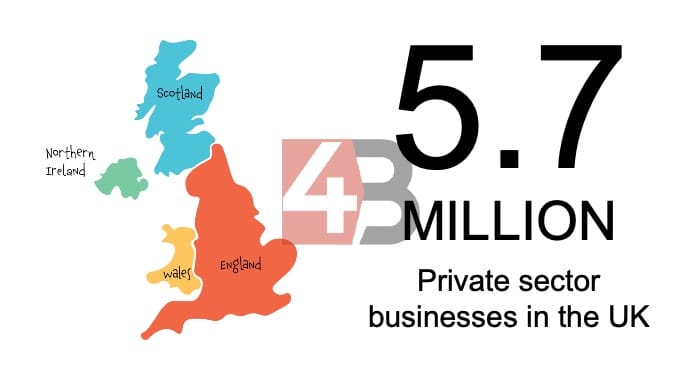
There were estimated to be 5.7 million private sector companies in the UK in 2025 (up 3.5% from 2024). This is almost entirely (99.85%) comprised of small and medium-sized businesses – and is responsible for generating 51% of the total turnover.
Firms with no employees account for just 16% of all employees but generated 7% of all turnover.
The average turnover of all UK businesses at the start of 2025 was up 5.8% on 2024 (£5.2 trillion). Some regions saw higher rates of turnover (with London having the highest rate of £1.4 trillion). However, every region in the UK saw annual average turnover increase in 2024. In regions with relatively low average turnover (Wales, Scotland, Northern Ireland, South West, North East, and Yorkshire), turnover growth is as high as 10% since 2022.
| Business type | Size (number of employees) | Number | % of all businesses | Total Turnover (£ millions) |
| Micro | 1-9 | 1,150,87 | 20% | 701,248 |
| Small | 10-49 | 220,085 | 4% | 776,163 |
| Medium | 50-249 | 38,435 | 0.7% | 948,639 |
| Large | 250+ | 8,335 | 0.15% | 2,696,001 |
How many micro businesses are there in the UK?
There are 5.4 million micro businesses (0-9 employees) in the UK, accounting for 95% of all companies.
The total turnover of a micro business in the UK is £701,248 million.
The number of micro businesses fell slightly in 2025, while the number of other business sizes remained relatively stable. In total, the number of UK businesses rose by 191,000.
How many small businesses are there in the UK?
There are 5.6 million small businesses (with 0 to 49 employees) in the UK, 99% of the total business population. This makes small companies by far the most common type of business in the country. Interestingly, small firms are also responsible for 34% of total turnover.
The total turnover of small businesses in the UK is £1.9 trillion, while the average turnover per company is £339,286.
How many medium firms are there in the UK?
There are 38,435 medium-sized companies (with 50 to 249 employees), 0.67% of the total business population. This means medium-sized firms still only make up a very small amount of the total UK corporate population.
The turnover for medium-sized businesses is £948,639 million.
How many large businesses are there in the UK?
8,335 companies were large businesses (with 250 or more employees), 0.15% of the total business population. This makes large firms by far the least common size of business in the country.
The turnover of a large-sized corporation in the UK is £2.7 trillion, which is 49% of the total turnover.
How many black-owned businesses are there in the UK?
There are approximately 330,000 companies in the UK that are ethnic-minority led. This accounts for around 6% of the total number of registered businesses. However, it should be noted that this includes all non-white ethnic groups.
Given that ethnic minorities make up around 18% of the overall UK population, this highlights there is still work to be done to increase the number of ethnic-minority entrepreneurs in the country.
UK Company Birth & Death Rates
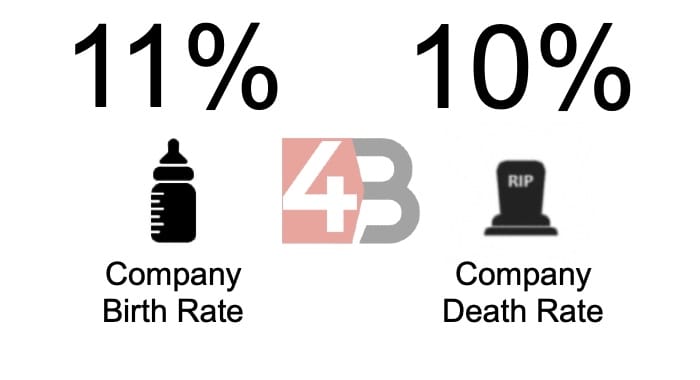
When looking at how many companies are formed, and how many are dissolved each year there are some very surprising facts.
In fact, the annual business birth rate is around 11% and the death rate is around 10%.
How many new companies are started in the UK?
A 815,277 firms started in 2025, up 1.67% on 2025. The fastest growing region Northern Ireland (+26%), followed by Scotland (+7%) and England and Wales (2%)
This figure remains significantly higher in the years immediately preceding the Covid-19 Pandemic.
Year by year new company incorporations:
| Year | New Incorporations | Y/Y % Change |
| 2025/26 | 815,277 | +1.67% |
| 2024/25 | 801,864 | +10% |
| 2023/24 | 900,000 | +12% |
| 2022/23 | 801,806 | +6.4% |
| 2021/22 | 753,168 | -7.1% |
| 2020/21 | 810,316 | +21.8% |
| 2019/20 | 665,495 | -1.1% |
| 2018/19 | 672,890 | +8.5% |
| 2017/18 | 620,285 | -3.8% |
| 2016/17 | 644,750 | +5.9% |
How many new businesses fail in the UK?
Almost 1 in 5 (20%) of new ventures fail in the UK each year. 60% of new firms will fail in the first 3 years and only around 33% will make it to being a decade old. This reflects the challenging nature of starting, growing and maintaining a successful business.
In 2025 to 2026, there were 787,120 dissolutions in the UK, a year-on-year increase of 8.3%.
Year by year company dissolutions:
| Year | Dissolutions | Y/Y % Change |
|---|---|---|
| 2025/26 | 787,120 | +8.31% |
| 2024/25 | 726,735 | +9.6% |
| 2023/24 | 663,167 | +13.2% |
| 2022/23 | 585,807 | +0.7% |
| 2021/22 | 581,824 | +32.9% |
| 2020/21 | 437,790 | -18.5% |
| 2019/20 | 536,934 | +5.5% |
| 2018/19 | 508,865 | +3.7% |
| 2017/18 | 490,738 | +12.4% |
| 2016/17 | 436,526 | +9.2% |
What are the biggest concerns for companies?
Labour costs is the biggest concern for businesses at the start of 2026, with 34% stating that they are impacting business turnover. This is closely followed by economic uncertainty, which is now a major challenge for 29% of companies.
The negative impact of inflation is still biting with 24% of firms saying the cost of materials will impact turnover compared to 22% in September 2025.
What is the average age of a UK company?
The average age of a company on the total register at the end of March 2026 was 9.2 years. Despite fluctuations in recent years, the average age of a company has gradually declined from 10.7 years at the end of March 2000.
However, there was no change in the years 2021/22 to 2022/23, indicating a possible stabilisation in the statistic.
Statistics For The Types Of UK Company
The UK is home to a wide range of different types of company. Here we look at some of the most common and the stats around them.
How many hospitality businesses are there in the UK?
There were 176,685 hospitality businesses in the UK in 2025, 3.1% of all UK companies. This is an increase of almost 50,000 businesses in this sector compared to 2023.
In 2025 the hospitality sector contributed £69.6 billion in Gross Value Added to the UK economy, around 2.8% of total UK economic output.
There were 2.7 million jobs in the hospitality sector in the UK in 2025, representing 7.1% of total UK employment.
How many retail businesses are there in the UK?
There are 304,560 companies registered in the UK that are classed as retail businesses, as of 1 January 2025
Retail businesses employ 2.6 million people represent over 8.2% of all UK jobs. In 2024, retail sales in the UK were worth £114.7 billion.
How many ecommerce businesses are there in the UK?
Although there aren’t any official statistics on how many commerce businesses there are in the UK, it’s estimated that there are between 300,000 and 400,000 online retailers in the UK.
With the growing popularity of online shopping, accelerated partially by the COVID-19 pandemic, the share of ecommerce firms in the UK has grown significantly over the last few years.
Online shopping as a percentage of all retail sales peaked at nearly 38% in January 2021, having stood at 8% at the start of 2011 and 19% in February 2020. It has since fallen back but remains around 27.4% in the latest period (2025).
UK Business Growth Rates
- Companies with a business plan grew an average of 30% faster than those that didn’t
- Firms with a business plan were also 2x more likely to get investments or secure loans than those without.
VAT & Tax Statistics
- Total VAT receipts in the tax year ending March 2024 increased by 7% from the previous tax year (to £168 billion).
- The Wholesale and Retail sector continued to be the largest contributor to net Home VAT liabilities, contributing 32% of the total
- 75% of total net Home VAT declared was paid by traders with an annual turnover greater than £10 million.
- Out of the 2.77 million VAT and/or PAYE businesses, only 59,000 operate from more than one site.
How many VAT registered businesses are there in the UK?
The number of Value Added Tax (VAT) and/or Pay As You Earn (PAYE) registered businesses in the UK is 2.6 million (at the start of 2025). This has increased slightly year on year.
International Trade Statistics
Following the UK’s exit from the EU, there is an increased interest on the impact on companies that trade with the EU.
How many UK businesses trade with the EU?
During the EU referendum debates, Vote Leave estimated that around 324,000 UK businesses traded with the EU. Meanwhile, Britain Stronger in Europe simply stated the figure was ‘over 200,000’.
Unfortunately, there are no official figures on the number of UK firms that trade with the EU. Still, we can estimate that the true figure is somewhere around 5-6% of all UK businesses.
How many UK businesses export to the EU?
Around 82% of all SMEs who are engaged in exporting are said to export to the EU. From this, it can be estimated that around 8% of all UK SMEs export to the EU. This figure drops slightly to 7% when all UK businesses, regardless of size, are factored in.
Small Business Data & Security Statistics
- 43% of UK businesses and 28% of charities report having cybersecurity breaches or attacks in 2025.
- Large businesses are much more likely to report issues with some 69% reporting breaches. But medium businesses follow closely with 65% reporting breaches.
- Across all businesses, the average estimated loss reported from a cyberattack was £0. This rises to £30 when looking only at medium at large businesses.
- 72% of firms say cybersecurity is a high priority for them. This is a similar level to the previous year.
- 16% of all UK companies send or receive digitised data, either personal or non-personal, to/from organisations or people outside the UK.
Conclusion
Despite the many challenges for UK business over the past few years, the overall performance and outlook is very encouraging.
Our review of the latest UK small business statistics has shown higher new incorporations at the same time as seeing lower numbers of company dissolutions. This is leading to overall growth in the number of UK companies.
Small business are easily still the most common type of company and a large proportion of them are being run by the owners without any employees.
However, the average age of registered businesses is falling, and only around a third make it to the 10-year mark. This is a slightly concerning statistic that indicates that many new firms are being created without a solid long-term strategy.
This highlights the need for better education of entrepreneurs to help them succeed in realising their ambitions.
Sources: Business4Beginners, GOV.UK 1, GOV.UK 2, GOV.UK 3, GOV.UK 4, GOV.UK 5, GOV.UK 6, GOV.UK 7, GOV.UK 8, GOV.UK 9, GOV.UK 10, GOV.UK 11, ONS 1, ONS 2, ONS 3, ONS 4, ONS 5, ONS 6, CREME, UK Parliament 1, UK Parliament 2, UK Parliament 3, BBC, ICAEW