Owning a business can be a dream. But starting a business from scratch is no mean feat, and for those who want to jump straight into running a known, loved business with an existing customer base, franchises are the perfect solution.
You gain instant access to an established brand, its trademark, proven operations, and trade secrets (shhh). All that’s left is to start trading.
But it is worth pointing out that owning a franchise isn’t just opening up a local McDonald’s (although it can be!). There are a lot of different routes and types you can take to being a franchise owner, which we’ll dive into in this guide.
So, what types of franchise are there in the UK? Let’s find out…
The 5 types of franchise operational models

Although there are hundreds of different franchise opportunities across multiple industries, you can categorise them into 5 types based on the way that they operate
Simply, the answer to what types of franchise are there in the UK is:
- Business format franchises
- Management format franchises
- Product and trademark franchises
- Owner-operator and mobile franchises
- Investment franchises
Simple right?
Let’s go into a little more detail on each so you can see exactly what they are and how they’re run.
Starting A UK Business?
Get rid of the confusion and always know what to do next with Startup Hive, the step-by-step platform created by the Business4Beginners team.
- FREE Step-By-Step Platform
- FREE Bank Account
- FREE Bookkeeping Software
- FREE Email Platform
- FREE Domain Name
- Discounted Company Formation
- Plus Much, Much More!
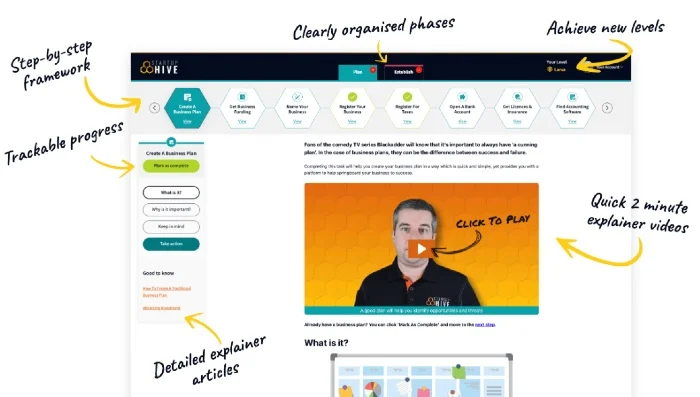
Join today for 100% FREE access to the entire Plan & Establish phases, taking you from validating your business idea through to setting it up, getting your accounts sorted, and creating a website.
“Excellent guide to build your business”
“The perfect starting point”
“Incredibly simple and intuitive to use”
Startup Hive is your trusted companion as you look to turn all of your business dreams into reality. Join today for free.
—
1. Business format franchises
This is the franchise type you might think of when you picture a typical franchise. This is where the franchisor provides a complete package for prospective business owners to buy, which includes everything such as:
- All brand assets, including names and trademarks (Salar and Salar, 2014)
- Business systems, which include business model and operational guidelines (basically a strict rule-book of how to run the business)
- All marketing and training needed.
This is the model that McDonald’s and others will operate under. It comes with many benefits, including a tried-and-tested system for running a successful business. There’s no guesswork: the playbook is right in front of you. And your success rate will be higher than with a new business (Othman et al., 2023).
However, it does mean less independence for you. You might own this business, but every move you make has to line up to the guidelines you’ve been given. For example, as a McDonald’s owner, you can’t suddenly decide to offer new menu items or change suppliers. It needs to be by the book.
2. Management format franchises

Management format franchises are where you focus on growing a franchise rather than doing the day-to-day services or labour. Typically, this type of franchise is common in business-to-business (B2B) sectors.
A good way to picture it is to think of owning a cleaning company. Instead of physically going out to do the cleaning yourself, you stay in an office, get new clients to sign up, and hand the work off to subcontractors or a team of staff.
This type of franchise is great for those who want more freedom in how they run a business, rather than taking on a traditional management role (hence why it’s called “management format”!). This is great for those with strong leadership skills, and means you don’t need to have expertise in that specific industry to excel. In other words, you don’t need to be a cleaner to run a successful cleaning business, as you’re the one cracking the whip, not wielding the feather duster.
3. Product and trademark franchises
Product and trademark franchises are where you buy the right to sell and distribute certain products. For example, a regional car dealership might buy a franchise from a specific car manufacturer. That’s how you end up with businesses like Vertu Motors having specific dealerships for Hyundai, Volkswagen, or Honda.
This type of franchise does give you more freedom than a business format, as you can run your business how you want. You just have rules on how you sell or advertise the specific product that you have franchised. It also means less start up costs and royalty demands, which can be an attractive bonus.
On the flip side, you will likely have less training and support for this franchise type – and you will be on your own for the day-to-day operations of your business.
4. Owner-operator and mobile franchises
This franchise type is designed for those who want to go the flexible self-employment route and deliver services to clients from home or through mobile service vehicles. For example, this could be anything from car valeting, online coaching, or even running a local Slimming World group.
This is great for people who want the hands-on experience of running a business at the hours that suit them, without the big overheads of having to hire a team of staff.
5. Investment franchises

This type of franchise is for those who want to invest in a franchise but don’t want to be involved in running it day to day. In these cases, they provide financial resources and then hire professional management to oversee the rest. This is common in industries like hospitality and hotels, retail chains or fitness centres.
This is great for those with a lot of capital, but not a lot of time. But if you’re looking at being your own boss, it’s more likely that one of the other franchise types will be more suited to what you need.
Ownership structures and scale also impact franchise types
As well as being different management types, the scale and ownership structures also make a big difference to franchises.
If you’re looking to start with franchises and are a first-time business owner, it’s more than likely that you’ll be looking at single-unit franchises. This is where you own and operate one single business location.
However, there are other models on offer, including:
- Multi-unit franchises, where you commit to opening and operating multiple business outlets over a pre-agreed timeline within a defined region. For example, you could commit to opening 5 retail stores in a county within 3 years.
- Master franchises, where you acquire the exclusive rights to expand and manage the entire brand across a country or major region. This essentially means that you will own that franchise within this region and could sub-franchise to local operators.
- Conversion franchises, where you take existing businesses and rebrand and integrate them into a franchise. For example, taking independent coffee stores and turning them into Costa stores.
Like we said, it’s unlikely you’ll be looking at these options. But they are worth knowing – and could be a future game plan for once you’ve had success with your first franchise.
EXCLUSIVE OFFERS – Save On Your Accountancy Costs


Which franchise type is right for you?
Time for our standard boring line: only you really know what option is right for you. But to make it easier (and prevent you from having to read all the above again) we’ve summarised each type into this handy table.
| Franchise Type | Core Operational Focus | Ideal For | Pros | Cons | Examples |
|---|---|---|---|---|---|
| Business Format | Buying a complete, turnkey package including brand, operations manual, marketing, and full training. | First-time business owners wanting a proven playbook. | Instant brand recognition, tested systems, full training and ongoing support. | Low operational independence; strict adherence to guidelines required. | McDonald’s |
| Management Format | Managing teams and growing the business rather than performing the service directly. | Strong leaders and managers without specialized industry technical skills. | Operational freedom, focus on business growth/scaling, high leadership flexibility. | Focuses on team management and client acquisition rather than direct service execution. | B2B Services (e.g., Commercial Cleaning franchises) |
| Product & Trademark | Purchasing rights to distribute and sell specific branded products/goods. | Experienced salespeople/distributors wanting lower franchisor oversight. | Higher operational freedom, lower startup costs, reduced royalty fees. | Minimal operational support/training provided; day-to-day operations are self-managed. | Regional Car Dealerships (e.g., Vertu Motors for Honda/VW) |
| Owner-Operator & Mobile | Self-employed individual providing services directly, often mobile or home-based. | Individuals seeking flexible self-employment with low overhead costs. | Low startup capital, flexible working hours, no employee management overhead. | Business growth is tied directly to individual owner labour and time availability. | Mobile Car Valeting, Online Coaching, Groups like Slimming World |
| Investment | Providing capital and hiring professional managers/staff to handle daily operations. | High-net-worth investors/capital providers seeking passive business ownership. | Passive revenue stream, minimal day-to-day operational commitment. | High capital requirement; minimal personal involvement in daily running. | Hotels, Fitness Centers, Retail Chains |
Ready to join a franchise?
We’re here to help you every step of the way.
Want to make sure that a franchise is right for you? Check out our guide on all the pros and cons that you need to consider.
Ready to dive in? Discover how to buy a franchise, step-by-step, here.
Want more business advice, news and tips? Find everything you need at Business4Beginners.